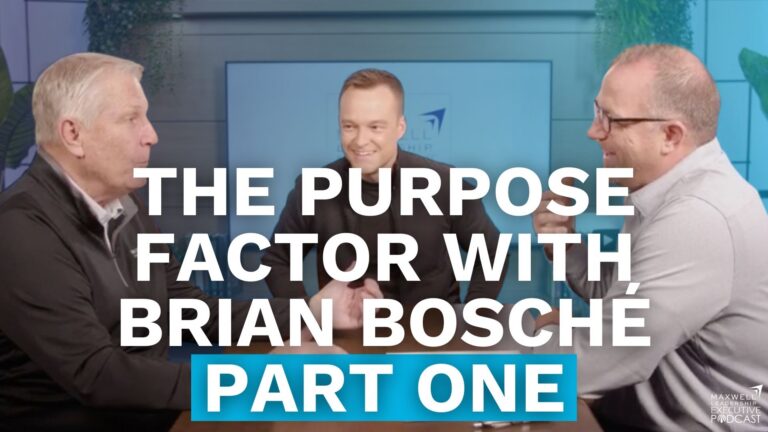
In this part 2 episode, Perry Holley, Chris Goede, and Brian Bosché continue their exploration of the connection between individual purpose, fulfillment, and leadership effectiveness. They illustrate how clarity of purpose not only reduces anxiety and burnout but also empowers leaders and team members to stay engaged and aligned with organizational goals. The conversation highlights actionable strategies for leaders to reconnect with the work that originally inspired them and to foster fulfillment without necessarily changing jobs. Listeners gain practical steps for integrating purpose-driven practices into team culture, ultimately driving long-term performance and engagement.
Perry Holley:
Welcome to the Maxwell Leadership Executive Podcast, where our goal is to help you increase your reputation as a leader, increase your ability to influence others, and increase your ability to fully engage your team to deliver remarkable results. Hi, I’m Perry Holley, a Maxwell Leadership facilitator and coach.
Chris Goede:
And I’m Chris Goede, Executive Vice President with Maxwell Leadership. Welcome and thank you for joining. Super excited that you’re here today. I’m just going to tell you as we open, if you didn’t listen to last episode, you need to go listen to it. I would encourage you to listen to it before you get here. This is going to be a continuing conversation because our conversation was just so rich about understanding not only your purpose, but your team’s purpose. And so we’ll get to that in just a minute. I want to encourage you go to MaxwellLeadership.com/ExecutivePodcast.
Chris Goede:
There you can click on a form and you’ll see a button up there. You may— you got a question, if you got a need, or if you’re looking for some training or some coaching inside your organization. One of the things we do is base everything here around John’s Five Levels of Leadership methodology. It is the common language in, in organizations. And so we would love to be able to help you and your team in any way. Well, as I mentioned, uh, this is going to be part two, uh, finding your purpose. And so we have with us Brian Bosché. He is the new president of Maxwell Leadership.
Chris Goede:
He and his wife Uh, Gab, we should have probably had Gab on here instead of Brian, but we’ll have that next time. We just wanted to set the tone with him first. She’s gonna close it. I promise you on that. But, um, one of the things we absolutely love about them as people and as leaders is their focus on helping people find their purpose and then the fulfillment. And that was so rich for me last episode about understanding the purpose and the fulfillment that they get from working on your teams and organizations you guys coach. And now we’re bringing that to Maxwell Leadership. So before Before we dive into some more content, tell us just real quickly, I know that you were a, a journal— journalist at one time, aspiring big screen TV news.
Chris Goede:
Uh, we just learned that, um, you were a law student and you took the bar exam. How did you end up developing an asceticism? Like, I know, and sitting at this table, give them a little bit of a laugh.
Brian Bosché:
You don’t go to school for this, right? You don’t go to school for this. You don’t— at 16 years old, you’re not like, I’m going to grow up and be an astronaut. You don’t grow up and say, I’m going to help people find their purpose.
Chris Goede:
That’s right, right.
Brian Bosché:
Um, doesn’t really happen. Wanted to be a national TV journalist, all Went to law school to be a better journalist. Got to be a journalist. I got to cover government corruption and terrorism right outta law school, uh, in kind of a documentary style unit. I was so excited. Uh, what nobody knew is that, um, I was getting ready to go through a divorce. My ex-wife walked out on me the week before I started the dream job.
Chris Goede:
Wow.
Brian Bosché:
Okay. So the depression had already begun. And then when I got laid off from the dream job a year later, the divorce was final. In the same month. And it was a, it was the first time I had ever experienced depression. And all these people, Brian, find your purpose, find your purpose, find your purpose. And I was very frustrated with that. I thought, I got really tired of the idea of purpose.
Brian Bosché:
I started out on purpose frustrated about finding purpose. Because it was like this journey-driven experience, like spend a bunch of money, go to Hawaii and maybe find yourself in a sunset. I’m like, this isn’t helpful. I’m broke. I can’t go to Hawaii.
Perry Holley:
I know what, I— I know what you’re— Yeah.
Brian Bosché:
Yeah. Walk across, find myself. Less than 1% of people ever find themselves. They just come back, you know, $10,000 less money in their wallet. You’re right. Going to find themselves. So I wanted something that was practical, that was tactical, and that could help me make a decision about what was next for me. And so I began this journey depressed, even frustrated with the word purpose, wanting to use it as a decision-making tool to help me know what was next for me.
Perry Holley:
Mm-hmm. Fantastic. Well, it is a, an assessment. And if it hadn’t been clear to you about the Purpose Factor and what Brian and Gab have brought to us, this, uh, it’s just been amazing for our team. We, uh, Chris put us through it. We, we took it seriously. We deep-dived on it. We had you debrief us on it.
Perry Holley:
We then began individually looking at what fulfills us in the roles we have and how does it play to our, to our purpose. One thing I noticed, um, a lot of the coaching work we do and working with organizations, there’s a lot of anxiety. There’s a lot of burnout. There’s a lot of people stressed at different places. And I wonder if you’ve noticed in the research, because I’m guessing if I really am clear about my purpose and my fulfillment Faktors, it tells me my fulfillment factor is part of this report. Does that— have you noticed that? Is that helping people shed some of this anxiety?
Brian Bosché:
Yeah, oftentimes you look at anxiety and depression not from a clinical standpoint here, right? Just talking about it from a coaching standpoint, a lot of it hangs out in and around fear of rejection, fear of uncertainty. When you help somebody find their purpose, discover their purpose, turn it into a decision-making tool, you’ve increased their certainty, you’ve increased their clarity, you’ve increased their confidence, and it has a natural reduction on things like anxiety and depression. Uh, clarity of purpose can actually extend your life as much as 3 to 7 years compared to the average, according to research as well. So it has a huge difference on that. But there’s another principle there too. For me, when I look at this and what this— all this research, over a decade of research, represents to me is something that I feel, uh, deeply committed to, which is internal freedom versus external freedom. If I help you find your purpose, I can make your mind more free. If I can make your mind more free, I can help you produce more freedom in your circumstances.
Brian Bosché:
When you read Man’s Search for Meaning, Viktor Frankl, famous book, one of the things that he says is when everything is stripped away everything is stripped, taken, taken from you. He says the thing that you have is the mental freedom, the ability to choose a better attitude. He talks about mental freedom. Mental freedom precedes external circumstantial freedom.
Chris Goede:
So when you were going through that journey, I’m sitting here thinking about everything stripped away. Did you— you probably didn’t have the language for it, but that’s— is that what you felt? Did you feel like when you had everything stripped away from you Yeah, I know you were working through some depression and stuff like that, but did you have that mental clarity?
Brian Bosché:
Yeah, I mean, and, and that’s how
Chris Goede:
it came up with the purpose, right? You kept— yep— digging, digging for the purpose.
Brian Bosché:
Pain is a powerful elimination tool. Pain is a powerful focus tool because everything you thought that mattered gets taken away, and it wasn’t by your choosing. None of those things that happened for me in that moment, they were not— that they were not my choice, right? That they were my circumstances. But there’s— and you know I love to talk about another word, my second second favorite word— first word is purpose, my second favorite word is conviction. Yeah, that’s another episode. That’s right. Right. But when, when you look at people who have high conviction, it started in moments where pain and clarity coexisted at the same time.
Brian Bosché:
And oftentimes the pain came before the clarity, or the pain was the clearing mechanism to get all the distractions and the things that you thought mattered out of your way.
Chris Goede:
That’s good.
Perry Holley:
Yeah.
Chris Goede:
Okay, so as a leader, right? And we’re going to go back to this. I know you’ve coached a lot and Gab has as well. The job can begin to feel heavy, right? If you’re not getting that fulfillment, which means you’re not in your purpose, right? What, what interventions, how have you coached leaders and team members to help them get from that, right, where their fulfillment came from, back to alignment of it, but not changing jobs, right? It’s like we’re working on the purpose and the fulfillment. What’s the intervention? How have you seen leaders make that transition or that tipping point to realize that they needed to take that next step to get to that point?
Brian Bosché:
The founder CEO is a really interesting case study because you started as a founder and you play all the positions and you might be the solo person. You’re like, you started it by yourself, no business partner. You’re doing everything. You’re doing the selling, you’re doing the delivering, you’re doing the quality control, you’re
Chris Goede:
doing invoicing, you’re doing it all of it, right?
Brian Bosché:
So your hands are in the work, your hands are in the dirt.
Perry Holley:
Mm-hmm.
Brian Bosché:
And then the more successful you become, the more administrative state you need to support that. And the further you get away from the thing that caused you to originally love the thing, you’ve created distance. So as the administrative state grows, as you get further and further away from the customer and the service and the product and how it impacts somebody, that distance puts you in the position to constantly give away, but not be close enough to receive fulfillment. Mm-hmm. Burnout looks like this: give, give, give, give, keep giving, keep giving, give inefficiently, not even giving your best, just give and give. And then all that distance, you’re getting nothing back in return.
Perry Holley:
Yeah, yeah.
Brian Bosché:
Burnout is the result of giving and not getting any emotional return on investment. To not see somebody’s life transform, to not get any gratitude, that— not that it’s about us, but not see any gratitude. That’s part of the— to not experience personal growth. And so the intervention there is, is to help the leader get close to the work and the result again.
Chris Goede:
That’s great.
Brian Bosché:
To make space on their calendar to say, you know what, it’s probably an inef— inefficient use of my time to coach somebody one-on-one, but I know when I coach this type of person on this type of thing and help them solve that type of problem, it fulfills me and it reminds me of why I started this company. That’s one of the key interventions that I’ve seen. You’re just too far away. You’ve got to get closer to the result.
Perry Holley:
Well, I can hear someone saying that this is great individual assessment for me personally, but we’re running a business here. And is it— can you help the leader out there, maybe the senior leader who’s having trouble connecting the dots about why— how is this going to help my business and not be too soft or too, you know, personal for somebody but didn’t help the business? I mean, how, how do they connect those dots?
Brian Bosché:
Purpose for me is a non-negotiable, and it’s about individual purpose, macro mission relevance. How can I draw a connection between the individual and the overall purpose, mission, and vision of the organization? If I can tie a thread between those two things and constantly remind them of that connection— purpose is a production tool, purpose is a performance tool. I always like— purpose is performance, because without clear purpose, without a clear pathway whereby I can experience full fulfillment, I’m not going to have a high degree or willingness to sacrifice. And so I’m just going to kind of phone it in. And so for leaders, it’s not to look at purpose as one of those soft skills or one of those workshops we did one time that nobody’s reading their report. The PDF’s buried somewhere in an email, right? We never look at it. I’ve got leaders that read this almost every week. They, they pick up their— they’ve got it printed off, they’ve got it spiraled, and they read it almost every single week because they’re trying to make sure that what they’re doing is relevant.
Brian Bosché:
And so it’s an organizational connection tool. It is an engagement tool. Again, I think I said this in the first episode we did together. They’re looking for a reason to stay, not a reason to leave. Why? By human nature, most team members don’t like uncertainty. To leave a job means to increase uncertainty. It doesn’t increase certainty, it increases uncertainty.
Chris Goede:
That’s well said.
Brian Bosché:
And so all of the re— actually, a lot of leaders, this is one of the biggest things. They’re always like, Brian, wait, wait, wait. You can’t have my people find their purpose. They’re gonna leave.
Chris Goede:
Right. I said, right, right.
Brian Bosché:
That sounds more like a you problem.
Chris Goede:
Yeah.
Brian Bosché:
That sounds more like a you problem. But if I can get them connected to their work, they’re looking for a reason to stay.
Perry Holley:
Well, I have a side question.
Chris Goede:
Do it. Yeah.
Perry Holley:
Sorry.
Chris Goede:
Yeah.
Perry Holley:
I was on a coaching call a couple months ago and it was a group call. And one of the— I have the senior leader, but I have their directs and it’s a car automotive business. And they said— I said, what do you do? And the guy says, I just service cars. And it blew all over me, blew all over me, but I had to remain composed. But I thought, I told the senior leader, if people on your team are saying that they just do something, am I, am I off base here? But it sounds to me like they’re not really clear on that thread you said between my purpose and your mission. You don’t just service cars. Yeah, you’re doing much more. You’re actually providing safe, reliable transportation for families in the local area to get from home to work.
Perry Holley:
I mean, I could on and make it as hokey as you want, but it seems like they have a very important role, but they’re not feeling it.
Brian Bosché:
Used in that sentence, just was a cuss word. That was— that’s how strong that word stands out. Upset me because it’s— I’ll never forget when I was going through all the tough stuff, divorce, depression, I had somebody in my life said, why don’t— Brian, why don’t you just be a lawyer? Mm-hmm.
Chris Goede:
I’m sorry, I didn’t know you just about 6 months. I can tell how I went over.
Brian Bosché:
Don’t want to just be anything, right? Why don’t you just end this conversation?
Chris Goede:
Okay.
Brian Bosché:
And so it touched a nerve. But Gabrielle was working one time with the California Highway Patrol. She was speaking on generational leadership styles and purpose as well. And she was talking about how this— I believe it was a sheriff, not a sheriff. It was, it was high up in leadership, was once having a conversation with a guy who actually worked on the radio transmission towers. That helped them all communicate in their cars. And the transmission guy was telling a story where his daughter came home from school and the daughter didn’t know how to answer the question, what does your dad do at work? And that leader that was talking with the transmission guy said, no, no, no, you, you save people’s lives when they’re having a heart attack. You help people in the very— by making sure that that thing’s working, you make sure that the precious seconds that matter after a near-fatal car accident.
Brian Bosché:
Yeah. That, that we actually capture the life in those seconds, right? It’s again, purpose, mission, relevance. If maintenance is done poorly, the tire falls off the car.
Chris Goede:
Yeah, sure.
Brian Bosché:
A family is at risk and it’s making it relevant again.
Chris Goede:
Good.
Perry Holley:
Yeah.
Chris Goede:
So talk to us about at what level do you then bring this into the organization? So we’ve been talking about it as a posture of self and about leaders. Would you look at bringing it in— at an individual contributor level? Would it be maybe, uh, the second in command? Maybe the C-suite only?
Brian Bosché:
Yeah.
Chris Goede:
In your experience, because you guys have done this with Fortune 500 companies, with smaller companies, where’s the best place to bring this in? And then how does it become that common language that we talk about?
Brian Bosché:
Yeah, it spreads most effectively from the top and then down. Sure. It always does, just like we learned from John Maxwell. That’s right. Influence works from the top 10% down. It is a trickle-down effect in organizations. If you start down here, right, if you start down here— and I don’t like the— I’m not a traditional org chart guy, right? I don’t look at it as a pyramid. One of my good friends and even a mentor in my life said, we need to turn that org chart upside down because the leader that is viewed as sitting at the top actually sits down here and puts that org chart on his or her shoulders.
Brian Bosché:
That’s a picture of leadership in terms of what you shoulder with your team, for your team. Um, that’s just a side note. Yeah, sure. But you start there at proverbial top because they, they, they do what they see. Your people will do what they see. So if they see leaders committed to getting individual clarity in their purpose and connecting it to the mission of the organization, when they see purpose being the primary decision-making lens, not just performance, the whole organization changes. For me in my life, I have to make a— I have to make a purpose case before performance case is ever, is ever a thing. We don’t get to talk about money, profit, revenue if there’s no purpose case for that.
Brian Bosché:
It’s going to be a short-term gain. It’s not going to be a long-term game. I can’t— I can’t do this for 3, 5 years, 10 years, a decade if I’m only playing a performance game. But if I play a purpose game first and a performance game always, I, I’m set up for long-term success. So I want to start up here in this executive C-suite, and then I want to work it down, then work it down, then work it down, because it has to work down by example.
Perry Holley:
So I had an impressive question about performance and how you relate, but I, you’ve been— I think you’ve really answered how these are connected. So let me— I’m just thinking about tactically, because I took this and I got this beautiful report and I was a little bit— it’s, it can be overwhelming. I mean, there’s a ton.
Brian Bosché:
I mean, I probably— 46 pages, I think it’s 46.
Perry Holley:
Well, I’m, I’m advanced, maybe mine’s 43. His probably, you know, yeah, 40, 45, 46.
Brian Bosché:
Okay, 46 if you count the back page.
Perry Holley:
Yeah. So what can you just— in this, a real life, uh, so you take, you take the assessment, you get this beautiful report. Can I— do you recommend people have a— you —did a beautiful debrief for us. But what’s the best practice once, once you have this?
Brian Bosché:
One of, one of my favorite things to do, it’s just a simple exercise, is get a green highlighter and a yellow highlighter. Take out the report, set aside 30 minutes, 45 minutes, hour if you want to take some time with it, coffee, whatever. Sit down with a green highlighter and highlight everything that you kind of already knew about yourself. Then with the yellow highlighter, Highlight everything you learned about yourself, because a lot of the things that are in there, you’ve potentially not had words or phrases to describe before, which means they were latent kind of abilities, skill sets, and gifts that you weren’t aware of. So it’s an awareness-creating document. If I can make you aware of the words and phrases associated with the best of what you have to help others— that’s purpose— the best of what you have to help others and give away, then I’ve just taken something from your unconscious mind to— up to your subconscious, right?
Chris Goede:
Not just— yeah, your subconscious to your
Brian Bosché:
subconscious mind to your conscious mind. And now it’s an intentional decision-making tool. Yeah. And so I also have like, uh, business partners do the same thing, but they switch reports, uh, which is so interesting.
Chris Goede:
Yeah.
Brian Bosché:
So you take his and vice versa. You highlight in green what everything you already knew about him, you highlight in yellow what you learned about him, right? Yeah. And, and oftentimes you’ll see a lot more yellow than green. Yeah. And this is where, um, you’ll see maybe that’s where a lot of conflict crops up because this is a place you didn’t understand him them as well and vice versa.
Chris Goede:
That’s good. Well, I’m going to wrap us up. That doesn’t mean that it’s the end of the journey around this for, uh, the Purpose Factor for you, for your team. You were saying earlier during the episode, uh, about leaders who just print it off and, and just kind of go through it once a week or, you know, themselves. This right here I’m, I’m holding up for those that are on YouTube. Those that are not, well, you might not want to look at Perry and I, so you can stay off YouTube. But if you are, mine’s in black and white. Perry’s going to hold his up in the color.
Chris Goede:
Yeah. This right here for your team, you know, you talked about gratitude and you talked about understanding your team. This is a one-pager that you could have and just look at, you know, hey, Perry and I are meeting, right? Whatever. I need to know this, I need to know that. And you can, you can lead with different things based off of this. It’s a great one-pager for yourself. You can definitely dig into it. And the reason I shared that is because I, I don’t think it’s optional.
Chris Goede:
For you to know your team’s purpose. You guys weren’t with us a couple months. I’m like, I’m in, team’s gotta take it. We gotta have a conversation. I had a— with one of my team, I had a year-end debrief and, um, I posed 10 questions and, um, that team member answered those questions. And then we took those questions and aligned it with the results out of her purpose factor. And we said, this is why. Hey, like, this is why.
Chris Goede:
And now we’re off and running in a new year doing things a little bit differently, communicating a little bit differently because we had the conversation around this. So thank you for all that you went through. Um, you’re back to living at home for 3 months. Yeah, 3 months. Uh, for doing that. But this is a tool, like we talk about on here, there’s lots of tools. This is a tool that I think will fuel and ignite your team members to be more engaged. And, and to live out with the conviction to be able to do what you’re doing.
Chris Goede:
And so Perry’s going to give you the, the URL in just a minute, but when you get there, I want you to click on that Explore Solutions tab. There’s going to be a form and just put your contact information and the purse factor, and we will be in touch because we want to add value to you and to your team. And we didn’t even talk about your family and your community and how you could use this. And so it can just go on and on.
Perry Holley:
Yeah, it’s a— it is a tool, but it’s a tool that keeps on giving a gift. It— we, we go back to it again and again, again to do that. So thank Brian, for being with us. Thank you, guys. Chris, great conversation. As a reminder, if you’d like to get the learner guide for this episode or, uh, leave us, uh, uh, the word Purpose Factor in a, in a comment there, we’d love to get information to you about that. You can do all that at MaxwellLeadership.com/ExecutivePodcast. You can also leave us a comment or a question there.
Perry Holley:
You know, we love hearing from you. So grateful you spend this time with us. That’s all today from the Maxwell Leadership Executive Podcast.
Transcript created by Castmagic.
Maxwell Leadership delivers corporate training that strengthens executive leaders, aligns teams, and transforms culture. Discover how our proven frameworks equip your organization to lead with clarity and impact.