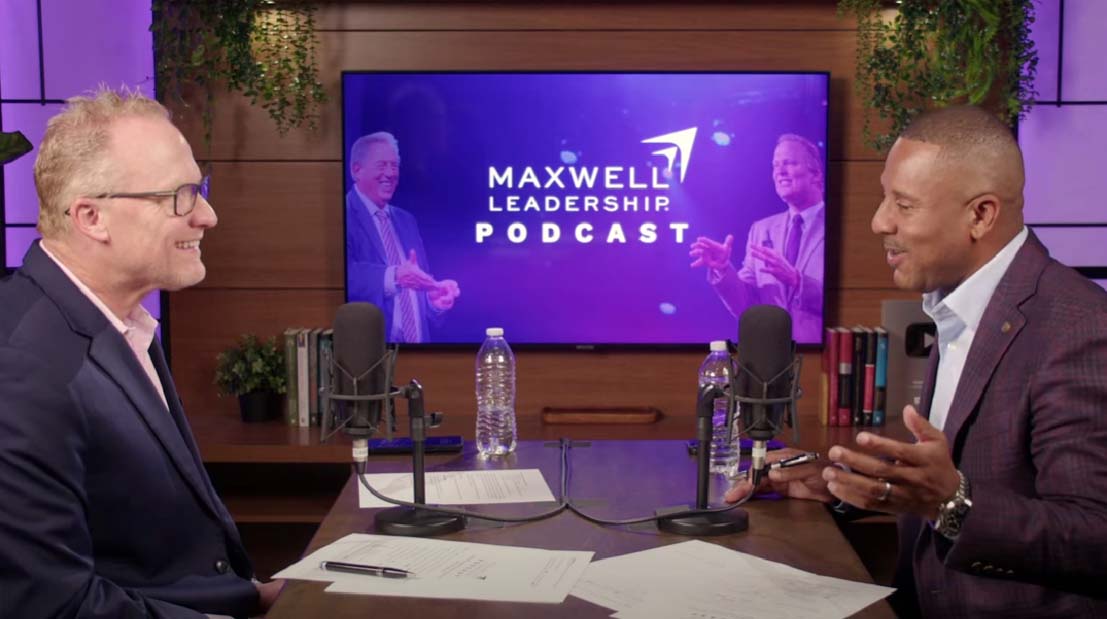
Are you striving for success, yet finding yourself wondering if your achievements really matter? The answer to a fulfilled life may lie in asking deeper questions, not just chasing accomplishments. In this bonus episode of the Maxwell Leadership Podcast, Mark Cole and Jared Cagle are joined by author and professor Arthur C. Brooks to discuss the pillars of a meaningful life (especially in an age of emptiness).
Mark Cole:
Welcome to the Maxwell Leadership Podcast. Our podcast is committed really to you. We want to add value to you as a leader so that you will multiply value to others. I’m Mark Cole, and today I am incredibly excited, not only because Jared Cagle’s beside me.
Mark Cole:
Dude, it is so good to have you in studio with me.
Jared Cagle:
Great to be here. Great to be here.
Mark Cole:
When I bring Jared in as our EVP of content, our executive vice president of publishing, you know something good is about to happen. And I promise you, hang with me just for another 2 minutes and then you’ll be hooked because today I bring to you Dr. Arthur Brooks. Now, some of you know him with his books. You know him because of his book, From Strength to Strength. Some of you know him because he’s a professor at Harvard Business School. He’s a number one Times or New York Times bestselling author. John’s heartbeat right there.
Mark Cole:
But he’s an expert on happiness. He spends his life helping you find the happiness within and spread the happiness around. His research has transformed not only his life, but the lives of his students, and like you and I, countless individuals who get the chance to learn from him through books and podcasts just like this one. Now, I’m super excited. I’m holding up a book that you can’t have yet. On March 31st, 2026, Dr. Brooks is releasing his latest book, The Meaning of Your Life: Finding Purpose in an Age of Emptiness. More on how to get that later.
Mark Cole:
We’re going to tell that. We’re going to post that in the show notes. But Dr. Brooks, I really have to tell you, from mutual friends, from people that I’ve heard, and from your own work impacting my life, thank you for joining us today on the podcast.
Dr. Arthur C. Brooks:
Thank you, Mark. Thank you, Jared. What an honor it is to be here. I’ve been following what you’ve been doing and The Maxwell Method. That’s been lifting people up and bonds of happiness and love around leadership ideas for a long, long time. So I feel like I’ve been on the road to talking to you finally about our issues together for years. What a delight it is to be here. Thank you.
Mark Cole:
Yeah, likewise, likewise. And again, John, these are the moments that I finally get to make John Maxwell jealous because I was telling him early this morning that I was going to be on the phone with you. We’re both familiar with you and some of the work that you’ve done. And he was like, Mark, these are the moments that being in Florida is not good. Now, if you’re listening to this podcast live, that is a big statement because he’s in Florida right now in the middle of winter and he’s like wanting to be in studio with us.
Dr. Arthur C. Brooks:
So, you truly have to— Well, I’m in California and I have to say John’s smarter. I know the tax rate difference. That’s exactly right.
Mark Cole:
That’s exactly right. I’ve got to ask you, so why another book? What was it about the message of this book, this idea of the meaning of life is a culmination of where you are now, what you have been doing, and what you— the message you need to get out in the future?
Dr. Arthur C. Brooks:
Yeah, it was— this book really was inspired when I first came back to academia. I’m an old-school academic. I mean, I got my PhD a long time ago and I started teaching decades ago, but I left in the middle of my time. And when I left academia, I went to college at Biola University in California in 2008. It was a happier place than the rest of the universe. I mean, people were falling in love on campus and making lifelong friendships, and they were laughing and having a great time. And I came back 11 years later in 2019, and man, it was dark. It was a completely different kettle of fish.
Dr. Arthur C. Brooks:
Campus was a worse place than the rest of society. People were unhappier, they were angrier, they were more afraid, they were more depressed, they were more anxious. I went onto campuses in 2019. I found that 55% of the students were seeking mental healthcare. Healthcare, but 55% is a lot. And so I started asking myself, okay, what’s up with this? Now, as a behavioral scientist, this is my Sherlock Holmes moment. When I walk onto any scene, I go into a company, I see a family, I walk onto any sort of cultural environment and I start to see a lot of unhappiness, I’m gonna— my antenna are up, I’m gonna start looking for the result. Why? What’s going on here? So I start interviewing students and looking at data.
Dr. Arthur C. Brooks:
This is what I do for a living. And what do I find? I find that the number one predictor of depression and anxiety for people under 30 today is believing that their life is meaningless, that they don’t know what they’re meant to do. Now that’s a big issue, man. And a lot of us kind of wonder about that sometimes, but when a whole generation suddenly after 2008 starts to find it harder and harder to find the meaning of their lives, something’s going on. So I had three questions. What is the meaning of life? What’s the meaning of meaning? Number two, where do you find it? And how do you live differently so you have the presence of meaning in your life? And this book is the 6-part method in 6 months to solving that problem.
Mark Cole:
So, dig just a little bit deeper with me. Double-click on this idea of meaningless. And now, I mean, I’ve got a daughter, second year in the University of Florida, and I’m going to meet her friends and I’m going, “Well, this is not what it felt like for college for me.” And you’ve hit on something in today’s culture, especially these young adult strivers. What is it that your research has found about young people in their search for meaning in life? Are they open to this concept?
Dr. Arthur C. Brooks:
Yes. Well, everybody’s open to the idea of meaning, but most people never really ask about it very specifically. Most people just kind of find it. And for the longest time, all throughout history, nobody had to ask these questions. Only philosophers asked these questions. Only, you know, St. Thomas Aquinas and, you know, Aristotle would ask about these meaning questions, but everybody else because they didn’t find it missing. You know, I mean, your great-grandfather never came home and said to your great-grandma, “Honey, I had a panic attack behind the mule today.” No, his brain was working the way it was supposed to work.
Dr. Arthur C. Brooks:
And something has happened, especially for people under 30, doubly especially for the strivers in places like college campuses where their life changed and these questions became impossible to answer. Maybe even they were less likely to ask the questions in the first place. So that’s where the search really started.
Jared Cagle:
Dr. Brooks, you talk about the happiness equation. Yeah, and I’d love for you to break that down, maybe just the factors that are in the equation and why that’s important.
Dr. Arthur C. Brooks:
Yeah, I mean, this really does lurk behind the meaning problem, and the reason is because happiness, as is best defined by neuroscientists and social scientists, is not a feeling. Now, feelings are related to happiness, like the smell of your turkey is related to your Thanksgiving dinner. The smell of the turkey is evidence that it’s Thanksgiving, but that’s not the same thing. You go to Grandma’s house and, you know, she says, take in the smell because that’s all there is. You’re going to be pretty disappointed that day. It’s just, you know, it’s evidence that something good is about to happen. Same thing is true for happiness and feelings. Happy feelings are evidence of an actual phenomenon.
Dr. Arthur C. Brooks:
The actual phenomenon has 3 parts to it. Kind of the protein, carbohydrates, and fat of happiness are enjoyment of your life, satisfaction with your achievements and accomplishments, and the sense of meaning of your life, of your existence. In other words, I enjoy my life, I know where I’m going, and, and my life has why. I understand the why questions of my life. And when one of those three things is blocked, you’re going to be depressed and anxious. That’s just the way it is, because you’re going to be blocked from your happiness. So when I’m going through an exercise like this, I’m like, okay, is enjoyment too low? Nope. Young people enjoy their lives just as much as anybody else ever did.
Dr. Arthur C. Brooks:
Is satisfaction low? No, satisfaction is the joy you take in achievements. And, and my students are all about achievements, man. They got tons of satisfaction. It’s meaning. That’s the one that’s cratered. And so just as, as depression among young people has tripled since 2008, anxiety has doubled. We’ve seen an absolute explosion in the answer to the question, does your life feel meaningless? An absolute explosion in the number of young people who say yes. That is big factor.
Dr. Arthur C. Brooks:
Happiness is low because meaning has been blocked.
Jared Cagle:
This is such an important conversation.
Dr. Arthur C. Brooks:
It is.
Jared Cagle:
I’m thinking about you the whole time too, because of your daughter and where she is in life and how many people are, are going through some of the same things. Dr. Brooks, I’d love for you to talk— I was fascinated in the book with this concept where you talked about the big questions that need to be asked, and, and you said, you know, it’s more important that you understand them than it is to find answers to them. Which I found that very interesting. Mark will tell you, I like to know the answers. I like to find the answers. Talk to me about how important it is to understand these big questions that you’ve presented.
Dr. Arthur C. Brooks:
So, the meaning of life really is a combination of big why questions. Number 1 is why do things happen the way they do in life? Number 2 is why am I doing what I’m doing? That’s purpose. And number 3 is, why does my life matter? That’s significance. Coherence, purpose, and significance. Those are big questions that you get an understanding of, but they’re very hard to answer specifically. Now, what we think of in modern life, and this kind of gets to one of the big problems that we have, is that the essence of being excellent is answering questions. And that’s one of the reasons that we love AI. That’s one of the reasons that one of the biggest companies in the history of the world is Google.
Dr. Arthur C. Brooks:
That’s a question-answering company. But the truth is that the essence of being fully alive, the essence of humanity is not answering questions. It’s asking questions. You know, there was this, and back in the old days when we were kids, there was that gorilla that they trained to do 1,000 words in sign language. Remember Koko the gorilla? Koko the gorilla was a big deal. And everybody’s like, Koko’s practically human ’cause Koko has 1,000 words and can answer all these questions. That’s wrong. Google can answer questions.
Dr. Arthur C. Brooks:
What Google can’t do is ask interesting questions. And Koko the gorilla literally never asked a single question in her life. And no non-human animal has ever asked a question. The essence of being alive, the essence of being a child of God, is asking questions, not answering them. That’s what it’s really all about. And that’s one of the reasons that the meaning of life comes from asking the big questions and sitting with the uncertainty. Why do things happen the way they do? I, I don’t know. I believe in God.
Dr. Arthur C. Brooks:
I believe it’s in the mind of God. I’m a scientist. I believe in the laws of science, but I don’t know exactly why. Why does my life matter and to whom? I’m trying to figure that out over the course of my life. What is my purpose? What direction am I going in? Why am I doing what I’m doing? I’m always trying to figure that one out too. That’s the essence of meaning, is sitting with those big questions.
Mark Cole:
So John wrote a book called Good Leaders Ask Great Questions. And what you just said about the essence of life is not answering, getting questions answered. It’s about asking questions and keeping that curiosity alive. And there’s no greater place, in my opinion, than when you get outside of your parents’ care and you begin to ask questions you never thought you could ask in college life, right? And so it’s so fun that this whole body of work has been founded in your experience where we’re most stimulated and rewarded at asking questions. Now, I’ve got another question for you, so stay with me. But guys that are watching YouTube, this is what I’m talking about. The meaning of your life, finding purpose in an age of emptiness. Dr.
Mark Cole:
Arthur Brooks is the writer, he’s the author, he’s the speaker on this. By the way, those of you that love Maxwell stuff, I am already twisting his arm to stand on one of our stages with John Maxwell, and I’m going to twist until I get him. So just hang in there, people. But I do not want you to hang about this book. The book comes out March 31st. Get the book before everybody else so that you become the champion. And by the way, do like me, don’t buy one, buy two, buy five, buy your daughter. If you have a daughter or son in college, my daughter will be consuming this book or I’ll stop paying her tuition.
Mark Cole:
How about that, Dr. Brooks? Hey, back to our founder. John talks a lot about the idea of adding value to others, how service is a great form of leadership. How does serving others contribute to happiness?
Dr. Arthur C. Brooks:
Well, a lot of this book is about the ways of living, the 6 ways of living that will make you find happiness, that will help you address those big questions. And one of those is actually serving other people. You know, Mother Nature is a funny beast because Mother Nature has set us up to survive and pass on our genes.. But Mother Nature has not set us up to be happy because she doesn’t care. And this is the funny thing about humanity. Humanity, unlike a golden retriever, a human being has two choices: animal impulses and moral aspirations. We get to choose, which is why we’re sort of divine in our way, right? If you live according to your animal impulses, then you’ll eat every Twinkie that comes your way. You’ll ruin your marriage, you’ll gamble away your money, you’ll take a bunch of drugs.
Dr. Arthur C. Brooks:
But if you live in the moral aspirations, then you can become a person who who really can aspire to something much, much greater. This is a perfect example, is serving other people. If you live according to your animal impulses, it’s me, me, me, me. It’s Arthur Brooks all day long. Man, it is so boring. It’s my job and my car and my money and my shows and my lunch, and it’s just terrible. But if I step back and I say Mother Nature pushes me to be the star of my psychodrama,. But I can decide that I’m not going to do that.
Dr. Arthur C. Brooks:
I can look at others. I can stand in awe of the universe. I can transcend myself. I can make myself uniform to God’s will, not just mine. I can serve other people and love my neighbor as myself because I choose to do so. Then meaning enters my life. Then I do that weird kind of unnatural but beautiful thing and I find a sense of meaning whether I can articulate it or not.
Jared Cagle:
This is interesting.
Mark Cole:
So good.
Jared Cagle:
Yeah, I’d love to go deeper here too. When you’re talking about Mother Nature, our brains are wired a certain way. Leaders who we talk to all the time, and a lot of our audience here, they’re driven, they’re passionate, they have big goals in front of them. And I’d love for you to talk about, okay, how can a leader manage what they want, manage this whole paradox that’s around us with Mother Nature and how our brains are wired, without losing that ambition and without losing that drive?
Dr. Arthur C. Brooks:
So that’s a question that a lot of my students have for me because I teach MBAs at the Harvard Business School. They want to grow up and be you guys. They want to be, you know, super impressive, absolutely at the cutting edge of their industries, making a lot of money, etc. And they’re making one big mistake, which is what all people do. It’s not their fault. We are told that to be happy, you need to pursue money, power, pleasure, and fame. That’s what Aristotle talked about. This is nothing new.
Dr. Arthur C. Brooks:
Thomas Aquinas talked about that. He called these the four idols. He says you want God, but you’re going to cut the corners and go for the things that feel a little divine— money, power, pleasure, and fame. Those are called the idols. I have a game I play with my students to figure out which one beguiles them the most. It’s called What’s My Idol? And I go through and I figure it out. I have a whole method for figuring out which one they’re going to choose the most. And if they know, then they’ll have power.
Dr. Arthur C. Brooks:
Here’s the deal. You cannot get happiness from following those things. If you follow the principles of happiness and meaning, then you will be successful enough in those things. See, that’s the trick, is actually understanding that you have to go for the goods. And to do that, you have to stand up to many of the impulses that you actually have. There’s nothing wrong with money. There’s nothing wrong with power. There’s nothing wrong with fame.
Dr. Arthur C. Brooks:
On the contrary, I’ve read John Maxwell’s books. I know how to be successful, and I’ve been very lucky in my career.. But when I’m going only for the money and the power, I’m going for the fame as the objective itself, I won’t find the happiness. When I actually use it as a way to serve other people, which is the deep Maxwell principle, that’s the one that he’s really talking about. Servant leadership means using your success to serve other people. And that’s the point that I’m trying to make, because when you do that, that’s when meaning comes.
Mark Cole:
So I have another question to get into your books, but I’m going to be a selfish father for a moment. I have a brilliant daughter, said no to a lot of full-ride academic scholarships here in the state of Georgia because she wanted to go to a better biology program outside the state. Very driven, very successful, but it’s not enough and she’s not enjoying the journey.
Dr. Arthur C. Brooks:
Right.
Mark Cole:
So it goes back— would you say that the quick snapshot of that, we need a lot more conversation, I’m sure, But would you say that as a parent, seeing my daughter as a part of this new generation that’s coming with all this potential, all this success— she’s much more successful in her studies than I ever was— is that perhaps because she’s not been able to link it back to the meaning that’s within her? So, she’s more about the progress and the accomplishment than she is about linking it back to the meaning?
Dr. Arthur C. Brooks:
There’s a lot of that. There’s a lot of truth in the end. There’s a lot of accuracy in the intuition. And again, I specialize in strivers. It’s funny, it sounds like I’m saying stop being a striver, become a slacker. But it doesn’t matter even if I did advise that, because I could give that advice to your daughter and she wouldn’t take it. Strivers are going to strive, man. That’s just the way it is.
Dr. Arthur C. Brooks:
Everybody watches the Maxwell Leadership Podcast is a striver. That’s why they listen to this. They’re not going to go slack. There’s nothing they can do. They need to add in the parts of their life that will make their striving worthwhile, that will make their striving meaningful. What’s missing from young strivers, and by the way, old strivers like me too, what’s missing from life is the why of the striving. Why am I doing this? Not, oh, so I can graduate from college. Oh no, not because then I’ll get a good job.
Dr. Arthur C. Brooks:
No, not because then I’ll get a promotion. No, no, no, it’s why am I doing this? Deeply, deeply, why does it matter to be excellent? And that’s what this book is all about, is the why behind all the things that people are actually doing. That’s what the subtitle is, Finding purpose in an age of emptiness and all the striving. There’s a ton of emptiness today. And finding the deep purpose, the why of life. Why am I going in this particular direction? Why does God want me to be excellent in that? Therein, when we go on that journey, that’s when meaning comes along.
Mark Cole:
It’s brilliant. So you talk about, you talk about striving, you talk about slacking, you write about another S word called suffering. You know the S word. So, but you teach that when properly understood, it can be a source of meaning. So, how can leaders reframe their struggles and their setbacks to extract meaning from difficult seasons?
Dr. Arthur C. Brooks:
The biggest mistake that people your daughter’s age have been taught and people a little bit older is that suffering is bad. It’s kind of like the hippies, man. I mean, Mark, remember in the ’60s? I mean, you and I weren’t around for the hippie generation, but almost. I remember, you know, Woodstock, I was like a little, I was a little kid, 5 years old when Woodstock happened. But I remember a hippie on TV saying, “If it feels good, do it.” And my dad saying, “That’s the end of America,” right? He was kind of right. But the problem was that that’s a terrible way to live. That’s just like pleasure as a source of happiness. And hitting the pleasure lever over and over won’t lead you to happiness, it’ll lead you to rehab, man.
Dr. Arthur C. Brooks:
It’s a big problem. But the same problem is what we have today in reverse, which is if it feels bad, make it stop. If I’m suffering, it means I’m broken. On the first day of my class at HBS, I tell my students, look, you’re students at Harvard University. If you’re not sad and anxious, then you need therapy. You’re doing something hard and you’re doing it on purpose. It’s funny because I’ve always taught my kids this. And, you know, 2 of my 3 kids are US Marines.
Dr. Arthur C. Brooks:
One of my sons was a special operations Marine. He was a scout sniper out of Camp Pendleton. And man, that is a hard life. That’s a scary life. That’s a dangerous life. And that’s why he did it. He did it because he wanted his life to have meaning. And one of the ways he found his life had meaning was when he understood the nature of his suffering and he stopped resisting.
Dr. Arthur C. Brooks:
Here’s how to think about suffering. Suffering equals pain times resistance. That’s the formula. Pain times resistance. What we’re doing wrong today is trying to reduce the pain from life. We need to start reducing the resistance of the pain in life. And how do you know when you’re doing it right? When you’re in a lot of pain, but you’re not suffering very much. When your pain is high, but your suffering is low.
Dr. Arthur C. Brooks:
You see this with wonderful old people, very religious old people, you know, people who are suffering cognitive and physical decline, but they have a deep, deep, deep religious faith. What you find is that their pain is high, but their suffering is low. And the reason is because they’re following scriptures that say, when I’m weak, then I’m strong. They’re offering up their pain for the holy souls, for the people who have gone before them, to, to serve other people, to be an example to others. So this is the way for all of us to think about it. There’s a lot of pain in life. My students will always say, like, “Professor, are you saying we should go looking for suffering?” I say, “Don’t worry, it’ll find you.” But when it does, you got two choices. You can put all of your energy and money and time in trying to lower the pain, or you can lower your resistance to it.
Dr. Arthur C. Brooks:
And when you do, meaning will come your way. And how will you know? Because your suffering will fall.
Mark Cole:
It’s so brilliant. It’s so good. It’s so good. Again, I hold up the book, The Meaning of Your Life, because that’s what we’re talking about, the content here. You said something recently, Jake, our podcast producer shared with me that you teach— I love application. And so this is an application for our podcast listeners. You teach your students to keep a failure and suffering list. Okay.
Mark Cole:
I just love this already. Talk to our listeners about— talk about that, but also tell us why is that so impactful?
Dr. Arthur C. Brooks:
So, you often get the self-improvement advice to keep a list of, you know, a gratitude journal. And that’s great. We do that too, to talk about the things that, you know, the positive aspects of life. And so, you can remember those things all the time. That’s good. That’s fine. But here’s what the real pros do. They keep a list of their disappointments and failures.
Dr. Arthur C. Brooks:
And here’s how it works, you know, especially for young people. Every— any given Thursday, their heart is broken, you know, whatever it happens to be. Write it down when you’re disappointed or you feel like a failure. Write it down in your journal. By the way, pencil and paper is best because it actually moves the experiences from the deeper primordial parts of your brain, the limbic system, into your prefrontal cortex, which is the tissue behind your forehead. That’s your executive center where you don’t forget things and can use them. So pencil and paper is really good. Your phone if you have to.
Dr. Arthur C. Brooks:
Write it down. Then 3 weeks later, come back to each entry and number 1, write down what you learned from this. You’ll have perspective after 3 weeks. Then a month after that, come back and say something good that happened as a result of that. And so every disappointment’s got 3 lines, the disappointment, the learning, and the benefit. And what you’ll find is after about the 4th entry in that journal, you’re gonna look forward to it. Something bad’s gonna happen. You’re gonna be like, oh boy, here we go.
Dr. Arthur C. Brooks:
Here we go. Because you’re gonna review all of that, and then it becomes generative. Look, you can make progress and have growth and learning from pain, or you can just have the pain and not have any learning and growth from it. You choose. And I’m finding ways for people to benefit more. Now, great leaders— John Maxwell has taught this a lot— great leaders are really, really good at understanding their learning and growth from their suffering. That’s a distinguishing characteristic. And the way that we can all be great leaders in our lives is learning and growing in meaning from ordinary pain.
Jared Cagle:
Let’s tap on that just for a moment as we think about the difference between meaning and happiness. Dr. Brooks, that is such a powerful example of why it’s important to focus on meaning. Can you describe maybe the difference between happiness and meaning? Some leaders we work with, you know, it seems like they— and I’ll use myself as an example— a lot of times I’m prioritizing maybe the wrong thing in this relationship between happiness and meaning. Why is it so important to focus on meaning instead?
Dr. Arthur C. Brooks:
Meaning is a macronutrient of happiness, and without it, we will find that happiness is elusive. So remember, happiness is a combination of enjoying your life, taking satisfaction in your life, and finding the why of your life, the why of your existence. The last part includes a lot of suffering. As a matter of fact, all of happiness includes a lot of unhappiness, which is one of the reasons that when people are trying to avoid their unhappiness, they never find their happiness. The main part of which being they will not invite the experiences that help them understand the meaning of their life. You will not be as happy as you can be. And again, I’m never going to make the case that you’re going to be completely happy because happiness isn’t a destination. Happiness is a direction.
Dr. Arthur C. Brooks:
You can’t be happy in life. You’re going to have negative emotions. They keep you alive, by the way, fear, anger, disgust, and sadness. You’d be dead in a week without those things. Those are an alarm system. You’re not going to have any way in life to avoid negative experiences because that’s part of life on Earth. Now, by the way, a lot of people watching us are traditionally religious people. So one side note about this, one of the great theories of the existence of something that’s hard to define is your hunger for it.
Dr. Arthur C. Brooks:
You know that water exists because you’re thirsty. You know that love exists because you want it. One of the reasons that I believe that heaven exists is because we want to be completely happy. We feel like we can, but we can’t do it while we’re still alive. For me, that’s evidence of heaven, right? But in the meantime, we’re not there yet, guys. We’re not there yet, which means that we actually have to make realistic goals, and that’s to get happier than we were before. Not perfect happiness, bad goal, but getting happier, that’s a really, really important goal. And you can’t do that unless you’re inviting negative experiences in your life and learning and growing from them.
Dr. Arthur C. Brooks:
And that’s really the part, that’s the essence of trying to captivate the meaning of why you’re around.
Mark Cole:
You know, it’s so interesting. So, I have a leadership bias, been with Jon for 25 years, and I’m sitting here going, “Okay, this is brilliant. I got it with my daughter. She’s going to have to read this galley copy before your—” You’ll send me the hardback because I’m going to order it from Amazon or from MaxwellLeadership.com, wherever. We’re going to put that in the show notes. Right on. She’s going to get it. But I’m now wanting to talk about, as a leader, we challenge our people to think about leaders.
Mark Cole:
We get content like this. We get access to you, Dr. Brooks, because we have a responsibility to the people that look to us for our leadership, for our influence. So how can leaders use these insights?
Dr. Arthur C. Brooks:
To better understand the people they lead? That’s a great question. Something I’ve thought about an awful lot as a teacher, for example. My goal, my sacred duty as a teacher is to lift people up and bring them together in bonds of happiness and love in the way that I do my work. I realize, I mean, I can say narrowly, my job is to run this company. My job is to teach this class. No, no, no, no, no. Your job is to bring people, to lift people up. So they can be uniquely their best selves.
Dr. Arthur C. Brooks:
That’s your ethical responsibility, but it’s also the privilege to be able to do that. So, what I’m thinking about when it comes to meaning of life is making sure that I am helping people follow their path of meaning. I am urging them to do these things. The number one best way for leaders to do that is to do that themselves. Now, I’ve been studying this for years. Literally, my professorship at Harvard is a professorship of leadership. And so, I’ve been looking at the best methods based on data ever to lead people in the best way. Is it to bark orders down the hall? No, that’s not the best way to do it.
Dr. Arthur C. Brooks:
Is it to write memos and make people read them? No. Is it to have tons of meetings? No. It’s to live the life of the person you want people to become. If you want your kids to grow up and go to church, go to church. If you want your kids to grow up and have good habits, have good habits. That’s the bottom line. And by the way, that’s where leadership starts is parenting typically. And if you want the people who work for you to actually get more meaning from their work, meaning from their interactions, meaning from their social lives, meaning from their professional vocation, then start doing that yourself, man.
Dr. Arthur C. Brooks:
That’s where it really starts. Charity starts at home, and it really starts with yourself. And that’s one of the reasons that I specialize in working with leaders themselves, because when their happiness skills are on point, when their meaning skills are on point, weird, people start to get those skills all around them.
Jared Cagle:
It’s so helpful. Such a helpful conversation. Speak to the leader right now, if you don’t mind, that’s maybe void of meaninglessness as they’re hearing you talk about it. They’re struggling within that area. And could you get practical with us? Maybe a few concrete actions that these leaders could take this week to begin building a more meaningful life.
Dr. Arthur C. Brooks:
So, leaders who are watching this, good news, you’re on the right track as you’re watching this podcast. That means that all is not lost. If you’re not helping yourself, that’s a really big warning sign. But if you’re doing something to help yourself, that’s a really good thing. The number one reason that leadership starts to feel meaningless in somebody’s life is that they’re very, very burned out and they’re disequilibrated in the work that they’re actually doing. They’re not leading a life of equilibrium. And again, I don’t believe in work-life balance. I believe in work-life integration.
Dr. Arthur C. Brooks:
The number one reason that you start losing a sense of meaning in your work as a leader is because you don’t have proper integration with the rest of your life. And the way to start doing that is by taking as seriously the things that are not work as the things that you do that are work. And look, I’ve suffered from this. I know what I’m talking about. There were— I was a CEO for a long time and I spent every 14th hour instead of the first hour with my kids, and I paid the price. They grew up. But I’m not screwing that up again. I’m a grandfather now and they live in my house, those grandkids, because I’m not going to mess this thing up.
Dr. Arthur C. Brooks:
The bottom line is that leaders who are watching us now who are feeling a sense of emptiness, it’s probably because your work-life integration is off and you need to start taking much more seriously your love relationships. This will make everything better, by the way. This will make your leadership better, by the way. And love is the essence of almost certainly what you need to bring meaning back to your work.
Mark Cole:
You talked about meaning. You talked about being in the business world. You’ve told us a little bit about kids, your children that have served the country. You’ve been in a lot of environments. You’re in one of the best, most respected educational institutions in the world. Give us one of your greatest lessons that you’ve learned personally. What is that lesson that has stuck with you in any industry, in any circle or sphere of influence?
Dr. Arthur C. Brooks:
Yeah, it is that what you seek as a person requires that you actually do the work yourself. You know, for years and years and years, I chased achievement so that I could feel the happiness that I was seeking, and that wasn’t the secret to it. The striving per se wasn’t the secret to it. Let me back up a little bit. You know, working with heavy achieving strivers a lot, a lot of them have the same couple of characteristics about their childhood. They tended to be really good at something when they were a kid, but here— but further, it goes a little bit deeper than that. The reason they were so good at something when they were a kid is because the relationship they had with adults was that they got affection and attention when they did something, and they incorrectly came to the conclusion that love is earned. This is the perfect recipe for taking a human being and turning him or her into a human doing.
Dr. Arthur C. Brooks:
And so, a lot of strivers, they grow up believing that love is not a grace freely given, that love is something as a commodity to be earned through excellence. This turns people into workaholics. It turns them into success-addicted, self-objectifying individuals. I have fallen prey to this and I see it again and again and again. This is the number one lesson I have to remind myself about, which is that I deserve and am capable of of experiencing love. Not just because I’m really good at my job, not just because I write books. And the same thing is true for everybody watching us. You deserve and you have the ability to be loved, but only when you break away from this fiction that you’re going to have to earn it.
Dr. Arthur C. Brooks:
And, you know, by the way, this is what ruins marriages. This is what ruins marriages where guys— it’s often different between men and women, by the way. It’s a very, very gendered thing, as a matter of fact, where guys feel like Like, you know, why are you so mad at me? The guy says to his wife, I work and I work and I work and I work to give you all these nice things. It’s like— and she says, all I want is you. But he doesn’t know how to give her him because all he’s doing is trying to earn her love by doing something that he believed once worked. Women do the same thing in different ways. The whole point is learning what love actually means is the secret to turning the key in the lock. And this is one of the key principles that goes all the way through this book.
Mark Cole:
It’s love, love, and more love. So I’m going to ask you one additional question and then ask you to share anything else you’d like to share to our listeners about the meaning of your life. But I’m sitting here knowing the year ahead of us here at Maxwell Leadership and this year of challenging people to find purpose. And we’ve talked a lot about meaning today. A lot of people talk about purpose. I don’t think many people talk about the meaning of life the way that you have both today and the way that you do in this book. I think you’re onto a new insight to an old journey. And the old journey really has been captured around the idea of purpose.
Mark Cole:
And you’re taking it a step further than purpose into the idea of meaning. So if you don’t mind, off script, don’t know if you’ve been asked this question, what’s the difference, the nuance between purpose and how you define meaning?
Dr. Arthur C. Brooks:
It’s a super important question. And the reason is because people use the two terms synonymously, but they’re not. Not the same. Purpose is part of meaning, but meaning is bigger than purpose. The 3 parts of meaning are coherence, significance, and purpose. Coherence is why things happen the way they do. Significance is why my life matters. And purpose is where I’m going and my goals and direction.
Dr. Arthur C. Brooks:
You gotta have all 3. And if you’re only doing purpose, which is goals and direction and goals and direction, we already talked about where that leads, man. That leads right down the alley of workaholism. Purpose is great. Purpose is super important. But when you shear it off from why things happen the way they do and why your life matters, you will sacrifice your goals and direction, especially professionally, for your love relationships. And that’s a really dangerous thing. That’s what you’ll— you’ll stop practicing your religion, you’ll stop serving your marriage, you’ll stop paying attention to your kids because it’s all goals, goals, goals, goals, and more goals.
Dr. Arthur C. Brooks:
So, purpose is super important. Finding your goals and direction in life, super important, but it must be accompanied by the other two dimensions of meaning so that it doesn’t wind up becoming something that’s your enemy as opposed to your friend.
Mark Cole:
My friend, as a parent of a kid in a very well-respected school and being a part of the critique of what are our students’ goals? Schools teaching our kids when we send them away. You’ve given me extraordinary hope as a parent, as a citizen of an incredible country, and as a guy that has committed his life to helping people realize their purpose and to reach it to its fullest potential. You have rocked me. So, I’m going to let you say anything else additional about the book that maybe we didn’t cover here.
Dr. Arthur C. Brooks:
And then I’m going to remind everybody how to get the book here as we wrap up. Thank you, Mark, and thank you, Jared, for this wonderful conversation we’ve been able to have today. Most importantly, thank you for the work that you’re doing in all of these podcasts and in all of the Maxwell project for bringing better leadership to the world. The one thing that we haven’t talked about that is a big thing in this book that people will find when they read the book is the role of technology and how that’s making everything harder. There’s a reason that this whole meaninglessness crisis spiked starting after 2008. That’s when everybody had a little screen in their pocket, my friends. And that was when we solved this little tiny problem that created a big crisis. That was the boredom problem.
Dr. Arthur C. Brooks:
We started to become distracted. And one of the things I talk about in the book is how the brain processes meaning. Meaning is processed in the right hemisphere of the brain. Technology is processed in the left hemisphere of the brain. The striving culture, the tip of the spear of that is the way that we use technology. And when we spend all of our time getting get rid of our boredom and distracting ourselves and spending all of our time online, we’re literally geographically in the wrong part of the brain to ask questions and understand what the meaning of our life actually is. And so, one of the most important parts of this book is how to get clean, is actually how to use technology in a healthier way, in such a way that your brain can work the way that it was actually intended. So, that’s That’s a big part of this book that we haven’t covered today, but the readers will find.
Mark Cole:
Oh, and we need it.
Dr. Arthur C. Brooks:
We need it.
Mark Cole:
We do need it. I can’t remember a time, Dr. Brooks, that I have been more intrigued and more inspired with one of our podcasts. Don’t tell John Maxwell I said that, but I really have thoroughly enjoyed this. I made a commitment and I’m making it again that we’re going to do more together. First thing we’re going to do is help you get this book into the hands of the people that we lead by consuming it ourselves first and then taking the people that we lead on a journey through the meaning of their life. And then by picking it up, those of us that are parents or grandparents picking it up. In our show notes, we’ll put the link.
Mark Cole:
But by the way, go to Amazon. Do not wait. Get this going. By the way, the way book sales, book ideas work, is the more you build momentum by getting it out there, the more it gets out there. It’s called shelf life, guys, those of you that are not in the world of books. And we need to give this a shelf life and we need to give this a bump by reading it, consuming it, and then passing it along. You can go check out more about Arthur Brooks at ArthurBrooks.com.
Mark Cole:
That’s ArthurBrooks.com. Go check it out. He will impact you. Well, Jared, what a great podcast. Dr. Brooks, thank you so much.
Dr. Arthur C. Brooks:
Thank you, Mark. Thank you, Jared. Uh, thanks to all of you in the Maxwell world and everybody who watches this. Remember that we have an opportunity with leadership to serve others, lift people up, and bring them together. And what a privilege that is.
Transcript created by Castmagic.